Wednesday, June 8, 2011

Memories: Year 1, Photos, Part 1


I've already given you a recap of my first year in Botswana in words, but I thought I should also give everyone a photo recap. Here is a collabe of my first three months of work in Botswana. I know, Prince William, children and wild animals are considered work. Tough life I lead, eh?


I spent my first three months working at the Botswana Predator Conservation Trust, primarily with its social development program, Coaching for Conservation, which teaches children about the wildlife and wild animals using football skills and drills. Last year was particularly exciting as we hosted an exhibition of our program for Prince William! After a month of tireless preparation, I fell deathly ill with a stomach parasite and missed the whole event!!! I was devastated. Fortunately, coworkers and friends provided me with photos. It doesn't ease the pain but it's nice to know my hard work paid off. The day was a fantastic success and maybe, just maybe, William will come back with his new bride.

*Side note: Prince Harry is constantly in Maun. Seriously, I'm always hearing, "oh, Harry's back in town." I've only ever seen him once but it's still pretty cool. He's treated like a local here and he's not considered a celebrity sighting. Anyhow, we also organize a weeklong Coaching for Conservation camp where over four days, we host 700 primary school children at the Maun Sports Stadium. It was a lot of work and a logistical nightmare but we pulled it off!

Working for a conservation organization has its perks, especially when your bosses own a research camp on the outskirts of the Okavango Delta. I was lucky enough to visit Wild Dog Research Camp more than once and witness the beauty and sheer size of open pans and floodplains of the Botswana bush. While I accompanied some of the researchers in the field, I was lucky enough to see up close and personal a leopard (pictured above. His name is Charles), lions, elephants, a wild dog den full of newborn pups and loads of other amazing animals. The great thing about going on a game drive with researchers is that they are tracking collared animals so unlike a regular safari, we could pinpoint the exact location of the animals we wanted to see and find them. It is truly amazing.

I hope you enjoyed my little recap. More photos of the following three months are coming up soon!

Emilie

Friday, June 3, 2011

Hockey Night in Maun and New Hockey Vocabulary

I'm back in Maun after spending the last few months in D'Kar and going home to Canada for my brother's wedding. (An update on life, work, home, Botswana will soon follow but today's topic is of utmost importance!).

My return to Maun has been a homecoming of sorts. I've been reunited with my friends, Blair, Jude and Willis (my Botswana family) and my first job. Also back in Maun is my Canadian friend Kyle. Last year, Kyle and I worked together at the Botswana Predator Conservation Trust and helped plan a major event attended by Prince William! Well, he's back again and I couldn't be happier.

Kyle and I are house sitting a cavernous house on the river in the Tsanakona Ward of Maun which is a bit out of town. Although the house is big and beautiful, it is definitely lacking in character, charm...and warmth. Most of the light bulbs are burnt out and those that work seem to be permanently dimmed. The kitchen is huge with a big island in the middle of it but it lacks pots, pans and most basic cooking necessities and worst of all the house is FREEZING! Kyle and I bundle up in socks, sweaters, even tuques to try to stay warm. It's usually a losing battle.

On the upside, the house has a big screen tv and DSTV (the Botswana equivalent of a satellite tv). Since I moved to Botswana, I've yet to have a tv. I tend to read a lot or watch downloaded movies on my laptop. But the beauty of DSTV in June is STANLEY CUP FINALS LIVE ON ESPN!!!! That's right folks, in the middle of the desert, in sub-Saharan Africa, I, Emilie Tobin, am watching the Stanley Cup Finals. Live.

It doesn't matter to me that I must get up (or stay up) until 2 a.m. to begin watching the game and suffer through little sleep. It even doesn't matter that I'm watching the game on an American network, although it has taught me some new hockey terms. Listening to NBC play-by-play commentator, Mike ‘Doc’ Emrick and hockey analyst Eddie Olczyk comment on the game and offer their analysis is like listening to a really aggravating comedy show. Some of their one-liners are classics, while other times, they display a complete lack of insight into the game of hockey, that it's hard to believe one of them actually played in the NHL.

Here are some of my favourite lines of the night:

  • By far the best new hockey term is "knifing the puck." Doc uses this expression often (actually he uses it constantly) throughout the game so it's difficult to pinpoint what exactly he's talking about, but from what I've deciphered, "knifing" is when players are battling for the puck on boards and a player pokes the puck out to his teammate. 
  • Doc's second favourite line is "punching the puck." To be honest, he tends to use this line for a variety of plays so I'm not quite sure what the heck he's trying to explain. 
  • Timmy Thomas. His name is Tim Thomas so why do all NBC announcers call him Timmy? It's kind of effeminate don't you think? 
  • The Alex Burrows biting incident. Yes, he bit Patrice Bergeron AFTER Bergeron shoved his glove in Burrows mouth. I understand that it is a suspendable offense, but what I don't understand is why Doc kept talking about it instead of doing the play-by-play? TimMY Thomas stops Jannick Hansen on a breakaway halfway through the third and Doc and Eddie still bring up the biting incident. Get over it and let Brendan Shannahan deal with it. 
Despite these little annoyances, I am so happy to be watching live Stanley Cup Finals all the way from Botswana.

Go Canucks Go!!!!!

Wednesday, April 20, 2011

Happy Anniversary

One year. It's been one year since I first landed in Botswana, grumpy and jet-lagged after a 48 hour journey of flight delays and cancellations. One year since I left my much loved apartment and traded up to a riverside mansion. One year...

I would've blogged about my one year anniversary sooner but D'Kar hasn't had internet for a good three weeks, and when it did return, there were more pressing things to do, such as find out the Stanley Cup playoff match-ups and figure out the candidates in my riding in the upcoming Canadian Federal Election.

But I think it's important to take some time to reflect on the last year. It hasn't been easy. As I've indicated in this blog a few times and in numerous emails home, I've struggled adapting to Botswana culture and to the impact of the immense expat community. I've also questioned my career choice more than once and wondered whether communications is truly what I want to be doing with my life. I've been angered by the seemingly nonchalant attitude of many people toward the HIV and AIDS crisis in this country and frightened by the statistics that show new infections are on the rise. It is hard to work day in and day out in the HIV sector when it seems like all our efforts lead to nothing.

Despite all these challenges, I still managed to have a wonderful year. I met amazing people and have made some great friends (special shout-out to Sharon!). I've discovered that I really enjoy working with kids and teens despite my lifelong disgust with children. I've enjoyed wonderful trips to Victoria Falls, Chobe National Park, the Okavango Delta, Tsodilo Hills, Namibia and Dog Camp with some great people. I fell in love. I ran 10 km for the second time in my life...and kept doing it almost daily. I've learned that I do not pick up new languages easily especially when "clicks" are involved.

I took part in the world's biggest sporting event and watched eventual World Cup champs, Spain, beat Paraguay in the quarter-finals. I lived with pets for the first time in my life. I survived without water. Not happily, but I survived.

Botswana has challenged, frustrated and angered me, but it's also inspired and amused me. I can't wait to find out what year two has in store for me.

I'm off to Canada in a few days for my little brother's wedding but come May, I'll be back in Bots, hopefully blogging a bit more than year one.

Emilie

Tuesday, March 8, 2011

Weekend in the Desert

I spent spent my first weekend in D'kar last weekend. I know I've lived here almost a month, but I hadn't yet been able to spend an entire seven days in a row here because of work and personal commitments in Maun and Gaborone.

I don't know what I expected. My initial thought was that I would be bored stiff. What was I possibly going to do in the middle of the desert for an entire weekend? But upon further reflection, I thought that I would take advantage of being alone and clean, do laundry, maybe bake, go for a long run, etc. I told myself, it won't be so bad. And you know what? It wasn't even though I didn't do anything of things I mentioned above.

Friday evening came along and wouldn't you know it, there was a house warming party at a coworkers place. I went over around 7 p.m. to see if I could help with any preparations. I was put in charge of meat marinade, which I never do in Maun because Blair, Sharon or anyone one of my friends have such excellent recipes. So I did what any good chef does: I tried to replicate their recipes. It turns out I never got to taste my meat as we ran out, but from what I've heard, it was a hit. Not sure how much it had to do with my marinade or if it had more to do with the free meat!

I met a lot of great people, danced up a storm in the rain and helped Laura chase away children who were trying to crash the party. It's a sad sight to see kids no older than 10 crashing a party in the middle of the night. We tried to chase them away but they kept coming back. Eventually, they started throwing rocks at us. The thing that bothered me was that Laura, myself and Peace Corps volunteer Molly were the only ones who seemed bothered that children were crashing our adult party. I'm sure this happens all the time, but it doesn't make it right. By the end of the night people were quite drunk, a few fights broke out and eventually people were asked to leave. This is not the type of behaviour children should be witnessing. Children replicate what they see and what they see in D'kar is adults drinking, fighting and partying, exactly the type of behaviour they tell kids not to engage in. So, kids are supposed to follow the mantra "Do as I say, not as I do?"

The following day, I had grand plans of working, cleaning and laundry. I wound up sleeping and reading all day. I woke up early, made some coffee and started reading The Girl With the Dragon Tatoo. I'm officially hooked. By noon, I was almost done the book. I passed out from noon to about 3 p.m. and continued reading, not even taking time to shower. By 7 p.m., I had made a Greek salad and was off to Laura and Anna's for a yummy dinner of spinach-stuffed pastry, gemsquash and my salad.

Another party was underway that evening at the primary school, more specifically at a teacher's residence. It was labeled a back-to-school party and people were supposed to wear their school uniforms. I went to a public school in Canada so I never had to wear a uniform, but low and behold, I showed up at that party looking like my teenage self. The temperature has been dropping steadily in D'kar the past few days. The rain has brought cold winds and for the first time since I got here, long pants and a sweater are a must. On Saturday evening, the rain came and with it more cold, damp weather. I put on my jeans, pumas and a hoodie. When I looked in the mirror, I realized that I looked a lot like my teenage self, except my jeans were a lot tighter than in grade 9.

Quick side bar: In Canada and I think in North America, if people were asked to dress up in school uniforms for a party, I am willing to wager that 95 percent of the girls would show up in a "naughty" catholic school girl outfit, complete with skirt hiked up to leave nothing to the imagination, bare midriff and intense cleavage. The sexualisation of young women in North America is overwhelming and everywhere. In D'kar, I was shocked that no one played the "half naked" card. Girls wore gym uniforms, long pants and button-down shirts (that were actually buttoned!) and ties. There wasn't much flesh and I was pleasantly surprised.

The party was a lot like the one the previous night, except this time, no one was kicking out the kids. I wonder what they thought watching their teachers get hammered? D'kar is a tiny community and many of the people holding down jobs are not from here. Take my office for example: there's one American, a Canadian, a Dutch woman and two locals. Kids see that most jobs are given to outsiders so what hope do they have for their future?

I went home after little less than an hour at the party. A terribly drunk man spilled about three drinks on me while telling me he loved me. It really was like high school!!!!

I was ready to be productive on Sunday. I really was. But mother nature had other plans. A big storm hit D'kar Saturday night cutting off the power from about 4 a.m. I could not work as all my files were on my dead laptop, I could not wash because there was no water and I could not cook because I don't have a gas stove. So I went to Anna's and read. I finished my book and started the second in the trilogy. I made some food since she thankfully has gas and read some more. It was so relaxing. The power came back around 8 p.m. But the weekend was already over. I survived. Not only did I survive but I managed to enjoy myself.

Don't know when I'll spend another weekend here. I'll be in Maun for a funeral next weekend and Gaborone for doctor's appointment the following but I now know that I am perfectly equipped to stay in little D'kar all by myself.

Friday, March 4, 2011

An Unexpected Loss

It's been a rough 24 hours. One of my parents nearest and dearest friends, the woman who introduced them, passed away from cancer. It was quick and sudden, but thankfully she was surrounded by the love and support of her family. Jill was a funny, caring, quirky and lovely person who like me, had one of the worst laughs in the world. When I was young, she used to tell me to listen to her because she was the reason I was around since she helped hook up my parents. A mother of two boys older than me, she also told me that I was the daughter she never had.

I haven't seen Jill in quite a few years. She lives in Victoria and me in Ottawa, but I have never stopped talking about her. People in Botswana know who Jill and her husband Jack are. I'm not kidding. People who know me, know I'm a talker so when I get going on something that I'm passionate about, it's hard to shut me up. Usually, I'm babbling about hockey, but sometimes, a select few loved ones are mentioned and Jill was one of those people.

A few hours after receiving news of Jill's passing, I received word that two people I knew drowned after their mokoro was overturned by a hippo in Maun. Apparently, three people made it to shore but the fourth person did not know how to swim and struggled to stay afloat. His friend returned to the water to save him but in a tragic twist of fate, they both drowned.

I am a strong swimmer. I always have been. Swimming has always been a part of my life. I don't even remember learning how to swim. I simply remember that swimming has always been a part of my life. It is not the case for most people in Botswana, or in Africa for that matter. In Botswana, which is landlocked, most people never have an opportunity to learn. There are rivers but they are riddled with crocodiles and hippos. And as such, there are many drownings in and around the Okavango district.

At my old house, a few friends and I began giving swimming lessons to local kids and teens from an orphanage. Many were scared to even touch the water with their toes during the first lesson, but eventually, most of them overcame their fear and began to enjoy the water. They jumped and splashed and it was hard to get them to listen to our lessons as all they wanted to do was play. The purpose of the lessons was twofold. We wanted to give these underprivileged kids the chance to cool off during the blistering summer days, but we also wanted to teach them about water safety and hopefully avoid more tragedies like the recent drownings.

We continually remind the kids that water is dangerous and that they have to be careful. We taught them to float and hold their breath. None of these kids can be called swimmers today, but hopefully with a bit of practice, they will have enough skills to make it to shore.

In memory of Jill, Omgee and Buddha. Live life to the fullest. Don't be afraid to take risks. And make the most of it.

D'Kar

In mid-February, I left Maun and headed to the settlement of D'Kar about 300 km away. I knew this was going to happen. I knew I'd have to leave the relative comfort of Maun and head out to the bush. I won't lie. I was apprehensive. I've had it pretty easy in Maun. Sure, I didn't have any water my last two and a half weeks in town, but I had friends who thankfully let me shower at their place. I also always had access to a grocery store, ATM, restaurants and an abundance of friends; all things I would be lacking in D'Kar.

Despite my reservations, I arrived in D'Kar with a positive attitude and ready to immerse myself in work and the town. To be honest, I was a little happy to be out of Maun because I'd had the worst week ever the previous week. My first day went well. I arrived around noon after an uneventful bus ride from Maun. Laura, my new boss at Letloa Health, picked me up on the side of the road and took me to my new house. I don't know what I was expecting, but I was pleasantly surprised. I've got a good sized kitchen, a big room and decent facilities. I even have water most of the time. And sometimes it's hot! Like boiling!!!! Its like heaven!

I'm working at Letloa Trust, one of the trusts that make up the Kuru Family of Organizations. The main goal of Kuru is to build the capacity of the San (they are also called Bushmen or Basarwa). There has been a lot of confusion and conflict about the fate of the San in Botswana. The San were traditionally hunters who switched to agriculture as the result of government mandated modernization schemes between 1950 and 1990. In the mid-90s, the San were forced off their ancestral land by the government who then utilized the land for tourism. The San were forced to give up their traditional livelihood and move to settlements. The relocation of the San has been a great debate in Botswana with support from some and disdain from others.. Kuru aims to empower the San and teach others about tolerance and acceptance of the San.

The goal of Kuru  is to develop a network of modern and professional development organizations with competent and responsible San leadership, facilitating a development process with marginalized communities to independently make informed decisions and to implement their own viable response to their situation.

I'm working with the Community Health Program which aims to prevent and treat TB. Although TB is curable, it is a lengthy treatment process and with many people living in isolated communities with no access to health care, it is a major killer in this part of the country. There is only a 59 percent cure rate in Ghanzi District where I work.

Letloa aims to raise that number to 75 percent in the next year. The first step is to bring the treatment to the affected communities. Through Community TB Care (CTBC), people in isolated settlements are gaining access to much needed health care. Not only are do they have access to health care in their communities, but they are receiving it in their local language.

There has long been a linguistic barrier between the health care workers and the communities they serve as many doctors speak English or Setswana. The San speak numerous traditional languages. The most commonly spoken language in D'kar in Naro. If, for example, a San from D'kar makes it to the hospital in Ghanzi, there is a strong possibility that they will not be able to communicate with the nurse or doctor. Since it already takes a lot of effort and time to make it to the hospital, many won't even bother since they are not receiving satisfactory treatment. Can you imagine walking into a hospital in Canada and you can't understand a single person working there? I know it happens to new immigrants and the older generation of immigrants, but in general, most us can leave the hospital with an understanding of what is wrong with us and how to deal with it. This is not the case for the San.

In partnership with local nurses and clinics, CTBC promoters ensure that TB patients receive and take their drugs daily. There are many patients who default on their treatment because they cannot make it to the nearest clinic to take their tablets. CTBC promoters bring the medicine to the patient in their homes. It is still a difficult task as many patients are not settled and move to farms or other settlements without telling the CTBC promoters. But it's a start.

The CTBC promoters do so much more than simply hand out tablets. They provide health talks to patients, family members and the community about TB symptoms and prevention, healthy living, the negative effects of alcohol while taking TB treatment and the link between HIV and TB to name a few. They test people for TB and encourage patients to test for HIV.

Community TB Care is working. Like any program, it has its challenges. We lack transportation to make it to the extremely rural settlements every month, there are still TB tablet shortages in the district as well as bottle and glove shortages to take samples. However, the program is growing and continues to improve. I am proud to be a part of its growth.

I used to fear coming to D'kar. I used to think this city girl couldn't handle herself in the bush. But I've surprised myself. Not only am I adapting, I think I'm thriving. I don't even dread the lonely nights as I've become accustomed to my nightly routine of running, showering (if there's water), cooking, working and reading. It's not even that repetitive to me. It might be a new found maturity (I recently turned 29), but I think it has more to do with accepting my situation and going for it.


Wednesday, February 9, 2011

Inspiration!!!!!

A Uniterra volunteer in Nepal recently posted information about this amazing young American woman who is literally changing lives in the tiny village of Surkhet, Nepal.

I now obsessivly follow her escapades as she navigates being a principal, teacher, mother and caregiver to a growing number of children in one of the most remote places in Nepal.

She is truly awe-inspiring. I do not aspire to do what she does. I think I'm a bit too selfish, but this woman reminds me that I can do more than what I've been doing.

Oh, and she's 23!

Check our her foundation's website and read her journal entries: Blink Now Foundation

Tuesday, February 8, 2011

The Village of Hope

I've been in Botswana for ten months now. I've had my ups and downs, some of them documented in this blog, others in personal emails. 

The beginning of 2011 has been a bit rough with the move and the appearance of the tennis-ball shaped cyst on my right ovaries which is extremely painful but benign.

I've been mopping and wallowing the last few days and frankly, I'm driving myself crazy. So this morning, I made it my mission to regain some gratitude. Funny thing is, I didn't have to look very hard to find it. I was going through some photos taken a few weeks ago at a ceremony to honour the graduating class at Motse wa Thsolofelo daycare and pre-school where I work, and I was instantly reminded of how lucky I am. 

Motse wa Tsholofelo Orphan and Vulnerable Children daycare was established in 2000 as a response to the needs of orphans and other vulnerable children in Maun, surrounding villages and settlements. The project is community-based and operates under Maun Counselling Centre. The daycare looks after 52 HIV-affected children aged two to six years-old and their caregivers. It provides educational activities, psychosocial support, meals, caregiver support and home visits to families.


Motse has a huge impact on both the lives of the children who attend the daycare and their caregivers. At the centre, children learn to develop social and academic skills that will prepare them for their future - both in school and in the community. The daycare supports orphan and vulnerable children from some of the poorest and hopeless communities in the regions. They are malnourished, vulnerable to illness and generally "forgotten" children. The centre provides them with three meals a day, basic education and a chance to play in a safe and friendly environment. Children learn basic social skills and how to interact with others.


Being a part of Motse is easily one of the best parts of living in Maun. The kids are hilarious and greet me with giant smiles and loud screams. Since they come from some of the poorest families in the region, their parents have no means to provide them with school uniforms or school supplies.

In December, 30 of our students graduated to Standard 1 (grade 1). We had a graduation ceremony where the kids wore caps and gowns and each received a diploma. To better prepare them for Standard 1, we partnered with an organization called Bonepwa + to provide each graduate with a new backpack filled with supplies to help them continue their education. We held another ceremony in early January to hand out these gifts to the kids before school started. 

It's moments like these that remind me that something so little like securing small funds for backpacks and school supplies make a huge difference in the lives of these kids. It's something to be proud of and it's a reminder that I'm doing some good here.

Below are photos from the graduation ceremony and the backpack ceremony.
The kids always put on a serious face whenever I try to take their photos. In an effort to make them smile, I place my fingers on either side of my mouth and show them how to smile. The photo above is the result: A bunch of kids with their fingers next to their mouth! At least the kid in the middle got it!

A graduating student receives her diploma from a volunteer teacher. Motse is run almost entirely by committed volunteers. The head teacher receives P2,000 (approximately $290 CDN) a month and the other teachers receive volunteer stipends of around $100 CDN/month.

A student patiently waits for his diploma.

One of the non-graduating students is all smiles during the graduation ceremony.

The backpacks I helped purchase with money from Bonepwa +.

The school supplies which will help our kids as they move on to Standard 1.

The kids explore the contents of their new backpacks.

My favourite little girl wears her best dress as she receives her new backpack.

The kids pose with their new school gear.
 

Thursday, January 20, 2011

You are all welcome in our home

I recently moved out of a huge, river view, air-conditionned mansion with a pool and into a modest, cinderblock home with no view, no hot water, no oven and tons of bugs!

The transition happened because the family I was living with moved to a smaller home and had no room for me. Housing is scarce in Maun and although I looked and looked, I couldn't find a place to call my own. Since no one offered me a couch, I reluctantly moved in with the guy I'm seeing. Reluctant because I'm just not ready to cohabit. I'm a very independent person and I enjoy my space. When I lived with the family, there was a lot of room for us to decompress and stay away from each other if necessary. Now, I do not have that luxury.

Instead, I'm faced with an influx of people who seemingly waltz in and out of my house whether they're invited or not. And eat our food, use our internet and complain when there is no food in the fridge. It drives me insane. My boyfriend and his roommate are from Zimbabwe and apparently this gives everyone an open invitation to our home. Makes sense, right? Not to this Canadian girl!

These boys have a strong sense of community, family and responsibility for others. In our case, our home is open to guests whether they leave at the end of the night or not and doubles as a storage unit for Zimbabweans who leave Botswana even those who may never come back. Seriously, we are storing a microwave-oven, a large metal chest, two computer monitors (not flat screen), two large boxes and a few camping mats for a man who left Botswana last year with no plans to return. But because he MIGHT return, we need to hold this crap for him...but we're not allowed to use any of it. We don't have an oven! I'm ready to rip that microwave oven out of its box and start cooking!

Maybe I'm just in culture shock, but I expect my home to be a safe haven; a place where I can go after a long day at work to relax, read a book, watch TV, do some yoga, etc. in relative peace. I'd also like to invite a few friends over but since I have no idea how many people will be in my house at any given time, I'm skeptical to send out invitations.

I know I've just moved in and it's not really "my" house so I've tried to be accepting but everyone has their limits. I pity the ungrateful, lazy, food stealing "guest" who feels my wrath when I finally blow up. It's coming. Wait for it.

Wednesday, January 5, 2011

Bring on the Russians

Tonight, Team Canada faces the Russians in a showdown for the gold medal at the World Junior Hockey Championships. This tournament is by far my favourite part of the New Year. Forget the parties, the champagne, the resolutions and all that jazz, the real wonder of the new year is seeing our young hockey talent take on the world.

Living in Botswana makes it difficult, if not impossible to watch any of this tournament. For some reason (probably the lack of ice), the Batswana would prefer watching Arsenal vs Chelsea or a game of cricket (which by the way, I still don't understand. How can a game last for days????).

Every morning, since Dec. 26, I wake up desperately needing TSN.ca. It used to be pretty easy as my house had internet access, but with the recent move (which I will update everyone about soon) and the office closed for the holidays, I was left texting my father in Canada and begging people who have internet in this town to check the score for me.

What a relief to know we demolished the Americans on Monday. I tossed and turned all night wishing I could watch the game and made sure to get the score as soon as I could. Now I must get ready for tonight. Although the game will start at 1 a.m. my time, I'm sure I'll be awake, stressing about the result. I love this championship. I love it more than the Stanley Cup Finals. But missing out on this year's tournament is the price I must pay for wearing flip flops and a summer dress on New Year's Eve.

Tomorrow morning, when I get to work and load TSN.ca, I fully expect to see our Canadian boys wearing gold!

Go Canada Go!!!!

How much is your life worth?

Three hundred and fifty pula. (about 54Canadian dollars)

That's how much the prostitutes who live near my house charge for unprotected sex. It's only 50 pula if you wear a condom. You'd be surprised how many people pay the big bucks for condomless sex, with reasons like "you wouldn't eat a candy with the wrapper on, would you?"

A lot of people prefer the feeling of unprotected sex, but that doesn't mean they partake in it, especially not with people they don't know and those who work in the sex trade. It makes no sense. Especially in Botswana.

The HIV prevalence rate in Botswana is 17.6 percent.

You do the math.

So, how much is your life worth?

Mine is worth a lot more than 350 pula and a hell of a lot more than a night of great sex.

Thursday, November 18, 2010

leth-ar-gy

leth·ar·gy 
[leth-er-jee]
–noun,plural-gies.

the quality or state of being drowsy and dull, listless and unenergetic, or indifferent and lazy; apathetic or sluggish inactivity.

This is how I've been feeling lately. Lethargic. It's most evident in my work. I'm struggling to simply work. I'm busy. I've got tons of stuff to do which usually inspires me, but for the last week, I sit at the computer and struggle to type. I want to spend my day on Facebook, even though I don't really like Facebook. I read the same articles over and over again in the paper and my obsession with gossip blogs is through the roof. It's like I'm finding any excuse in the world not to work. And it bugs me.
 
Although it's very evident in my work, this lethargy is taking hold of other aspects of my life. I haven't opened a book in about two weeks which is so unlike me as I've usually got a few on the go at a time. I hadn't blogged in almsot a month until I forced myself to do so yesterday. I wrote my piece for a newspaper freelance gig I have back home at the last minute because I just couldn't be bothered to write. I'd rather lay in my room watching movies 24/7. It's a depressing lifestyle. Not one that I am accustomed to.
 
This has happened to me before for brief periods of time, mostly when I was working for the govermenment and well, let's face it, that's an excuse enough in itself! But what's bothering me the most is this dread I have that I don't really like what I'm doing. I used to think I didn't like working for the government, but I'm starting to believe that it is the subjet matter and not the office that made me so miserable.
 
I don't think I like communications anymore. I was trained as a journalist but never really sought out that career as I was sucked in by the money and security of the government. I thought to myself, "communications is sort of like journalism." Well, it's not, and in the end, it's quite boring.
 
I know a lot of people work jobs they don't really enjoy. It's a part of life. And with my jobs right now, it's not all about communications. It's about communities and local organizations and building up their capacities so they can better serve their communities. So many of the organizations I work for are dedicated to child welfare and empowering children and teens. I respect and admire them and truly want to do my part in helping the organizations thrive.
 
So, I need to get my head out of my ass. Seriously. Who cares if communications isn't my passion? I have passions and while they might not be part of my employment today, eventually they will be if I so desire. This is an opportunity for me to learn more about myself - my likes, dislikes, strengths and weaknesses.
 
During my time in Botswana, I've learned that I enjoy working with children. Back home, I loath them. No joke. But here, it's different. Children suffer through unimaginable hardship and yet do so with a smile on their face. I'm not implying that all kids are happy smilly children. They aren't. But there is something special about working with kids in need. I learn so much more from them than I could ever teach them.
 
Therefore, my homework for the rest of the week is: Attitude of Gratitude. I need to be grateful to be here, to be healthy and relatively happy and simply accept that I am not 100 % happy with my choice of career so far. I'm on my third one anyways, so I know that I can change and move on as I please.

Monday, November 15, 2010

Diamonds in the Rough

I've complained a few times on this blog about the lack of anything remotely cosmopolitan in Maun. This wouldn't be so terrible if there was some sort of distinct culture, arts scene, theater, fashion... ANYTHING to balance the bush and safari culture that eats up this village.

I've been trying to alter my perspective, look at things in a gentler, softer way instead of through my pessimistic view. And you know what? I've found a few gems. The first being shopping. I know this is going to sound shallow to many but when you are surrounded by khakis and hiking boots 24-7, it's a delight to remember that Maun has some alternative options for those of us who don't spend most of our days in the bush and work in offices.

When I moved from Canada, I brought five suitcases. I packed most of my summer wardrobe and reasoned that I wouldn't spend any money on clothes in Botswana. In seven months, some of my clothes has been ruined by dirty water, some has disappeared and a lot of it has become boring.

So it's not like I had to shop but it was worth looking around.

Surprise, surprise. Maun's got a few gems. And I've got the photos to prove it.

My new favourite place to buy shoes is Pep. A mix of dollar store meets department store, Pep has by far the best shoes and the best prices in town.

Case study one: My studded flats.

I first came across these beauties when I saw my neighbour Sarah walking through our yard wearing these sandals. I immediately asked where she got them and proceeded to tell her that I would be purchasing the same pair. It took a while for me to find my size, but eventually I got my own pair for the bargain price of $54 pula (about $8 Cdn).


Case study 2: The Summer Dress

Found at my new favourite store Mr. Price, this pretty dress is a perfect weekend addition to my wardrobe. It's also great during the boiling summer months.


Case study three: Polka Dots

Again, a Mr. Price gem, this blue and white polka dot fake bustier is versatile enough to wear with jeans or a cute skirt. The flower belt adds a little flash of colour. For 50 pula ($8 Cdn), it's a steal.


Case study four: Flower Power

In my previous life in Canada, I thought I was too old to wear short skirts. Maun has squashed this myth because of the heat and because people simply don't care about how they look. So if I'm showing off what I think are less than adequately toned thighs, most likely, I'm the only one who's going to notice.

The skirt below is my latest purchase. I have no clue whether flowers and patterns are the rage in the real world, but I saw this skirt in a add in the paper and I decided it was the perfect summer skirt. I'm telling you, Mr. Price is amazing. It is my new favourite store and I have to stop myself from going there every day.


I plan on trying to make this a regular part of my blog. Not the shopping bit, but new and interesting tidbits I keep unearthing that make this place not just bearable, but sometimes, even enjoyable.

Sunday, October 10, 2010

Viva Espana: World Cup Fever

Ok, I know it's a bit late to be writing about the World Cup, but I started this blog 6 months after I moved to Botswana and I've done some pretty cool things over the last half year. So I will be updating everyone of my shenanigans in a belated fashion.

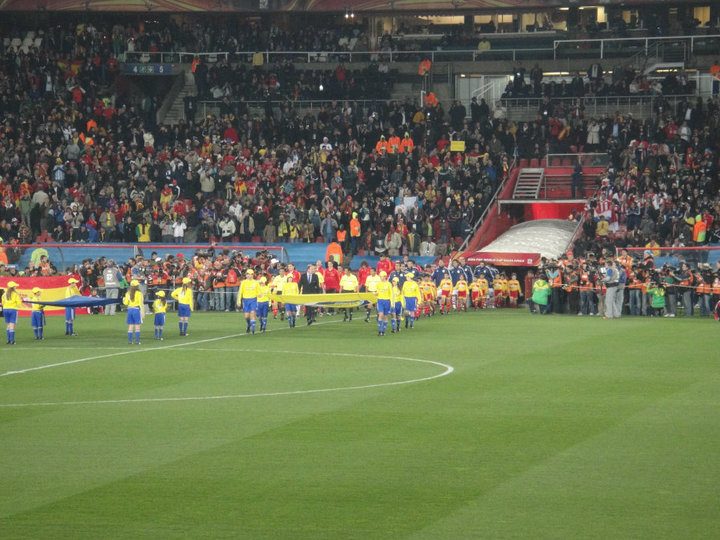
First up: World Cup. I don't know how I would have survived June without the biggest sporting event in the world. As you may have noticed from my last post, I'm a hockey junkie. Never cared much for football, or is it soccer, I don't know anymore! But as I struggled to meet people and to build a social life for myself, football (as I've decided to call it), help ease my transition. Pretty much every night of the week, I would head out to a local pub or restaurant to watch a game. Any game. I really didn't care. Since Canada has no team, I decided to cheer for my adopted continent. I cried with the rest of the continent when Ghana came so close to moving on to the semi-finals. I felt almost as devastated as when the Sens lost in the Stanley Cup finals. Seriously.

I'd thought about going to a game but I kept wavering because of the cost, the travel expense and the lack of a buddy to go with me. Then my friend Knight called on a Thursday evening saying he had tickets for Saturday's quarter-final match between Spain and Paraguay and invited me to come along. After a few phone calls to find accommodation (thanks Andrew), I booked a flight on Friday and Saturday morning, I was off to Joburg.

IT WAS TOTALLY WORTH IT!!!!!

We went straight to Nelson Mandela Square where we were greeted by the colours of the world. Spaniards, Dutch, Mexicans, Germans, Americans and a whole lot of other people proudly displayed their country colours by wrapping themselves in flags, painting their faces, donning hats. It was patriotism at its best.


Knight and I quickly decided we were cheering for Spain (my choice was based on the good looks of #14 Xabi Alonso) and proceeded to purchase some Spanish flags and draped ourselves in them.


As we were walking through the mall, we heard some cheering and clapping and turned to see team Ghana walking through the mall! Fresh off their devastating defeat the previous night, the team was given a hero's welcome as people from all over the world cheered, clapped and expressed how proud they were of their effort. It was beautiful. I almost cried.


The game was just as awesome. Knight told me we had good tickets but I didn't realize how good they were. As we walked into the stadium, we were directed to the lower level. We then started walking down the stairs, searching for row x. As we continued to walk down, I turned to Knight and asked him where exactly we were sitting. He told me to keep walking,

We stopped eight rows from the pitch. EIGHT ROWS!!!! Oh and we were sitting in about the centre of the football pitch! I could hear the players talking to each other. So amazing.Thank you Knight!


We watched the eventual World Cup champions squeeze out a victory against Paraguay. It was truly an amazing experience. One that I will never forget.


Thursday, October 7, 2010

Hockey Night in Canada


This is for everyone back in Canada who are gearing up to watch NHL opening night. Montreal Canadiens vs Toronto Maple Leafs. Classic rivalry. Wish I was home for it! Go Habs Go! (tomorrow, it's Go Sens Go!!!!)

Tuesday, October 5, 2010

Making a difference, one letter at a time

My role in Botswana to is to build capacity in the area of communication and information management. It has been a struggle particularly at the counselling centre. The centre is short of funds, as are many NGOs, and I have been utilized to write proposals and look for sources of funding. Not necessarily my job description. Also, one of our major programs, which employs about 17 staff, ended September 30. Therefore, most staff spent the past two months wrapping up the program, writing reports and polishing their CVs in hopes of finding new employment. I've been asked to write a lot of CVs and I've helped out after hours as much as I can.

There are many days where I can't help but feel like I'm wasting my time here. I've been working at Maun Counselling Centre (MCC) for two months and I don't know if I've actually made any type of difference. The point of capacity building is that when I leave, the people in the organization should be able to continue with my work. I just don't know if that can happen here. Especially in such a short time.

When people think of communications, they usually think about websites, newsletters, pamphlets, brochures, etc. Well, at least that's what management thinks about at MCC. But when an organization is struggling to survive, the last thing it has is money to produce these types of products. Also, for many employees at the centre, English is still a new language and the capacity to write these documents has not yet been developed.

When I spoke to employees, they informed me that their communication needs were far more basic. They want to learn basic typing skills, basic English language writing, how to take minutes during a meeting, etc. This isn't what I had in mind when I first came here, but I have to adapt to my surrounding and to the needs of people.

Another struggle has been the lack of enthusiasm, or maybe it's better described as apathy, in actually learning. Sure someone tells me they want to learn how to type, but when I ask them to type a simple letter, they say no. Same thing with taking minutes. Batswana are funny people. Many of that claim to want to learn, but don't actually want to do the work to get there. This has been my biggest frustration so far.

So imagine my surprise and deep delight when I walked into the office this morning and found a coworker practicing his typing using a program I found online and added to every computer in the IT room. Not only was he practicing, but he was teaching another employee how to use the program. Still working on lesson 1, which practices using the letters "F" and "J," he excitedly told me how he only made 23 mistakes during his last test. The first time he took the test, he made 191 mistakes. He is now working on lesson 2 and his typing is improving every hour!

This is the first time in two months that I've seen someone take initiative with anything that I've attempted to teach. Typing might seem like such a small skill, but if they get comfortable with the computer, then they might start typing their reports instead of writing them by hand. This simple skill will help them today and in the future wherever they may be.

If this is the only skill people learn while I am here, I will be satisfied. We need to start small. One key, one letter, one word at a time.

Sunday, October 3, 2010

Indifference or Ignorance

I work in an HIV and AIDS counselling and testing centre. While we test and counsel people at the centre, our main area of focus is education and testing in rural communities and local impoverished areas. On my first day of work, I went to a shabeen (a gathering spot where alcohol is brewed and sold) for a testing and counselling session. Field officers from work had previously scouted the location, talked to the owner (commonly known as Shabeen Queens) and held a session about the importance of knowing your status. A week later, a counsellor, outreach worker and myself showed up for the testing session. It is important to show up early in the morning before people get drunk. It's not recommended to test people while they are under the influence. Unfortunately, we arrived a  bit late (around 10 am) and most patrons were wasted already.

I've been tested regularly since I was 20-years-old. Every six months to be exact. Not because I engage in risky behaviour, but because I think it's important to know your status and to get in the habit of being tested regularly. I still get freaked out every single time I get tested. I get nervous, panicked, my skin feels clammy and I'm pretty sure all blood is drained from my face. Why? My deep fear of needles probably has something to do with it, but I grew up with the knowledge that sex today is a lot riskier than it was 30 years ago. And HIV is the biggest reason.

Maybe I'm paranoid. I know even my doctor thinks I'm crazy to get tested so often since I'm from Canada and our country's HIV incidence rate is approximately 0.02 percent. Which is why I have a difficult time comprehending how people seem so unfazed about testing here even thought the incidence rate is a staggering 17.6 percent.

I don't know if it was their drunken state, a lack of fear or ignorance, but the people at the shabeen acted like getting tested was a simply a normal part of their day. They chatted with the counsellor, got tested, received their results and no matter the result, continued drinking and talking with the rest of the patrons. One man who tested positive sat next to me and told me he already knew he was positive and that he didn't care. Slurring his words, he told me he was taking anti-retrovirals and that he was fine. He then asked me to have sex with him.

I guess it's good that he has taken his diagnosis well, has begun treatment and may well live a long and prosperous life. However, he is more likely sleeping with many women, passing the virus to them as well as to his wife, depleting his body with alcohol and reducing the effect of the antiretrovirals in the process and simply not caring much about his life or the consequences of his actions.

And that is the case for many in Botswana. HIV and AIDS is everywhere: in ad campaigns, in schools, in the workplace, on TV, at home, in the funerals held every weekend, and yet, people don't seem to take it very seriously. This isn't just a one-off observation, it's something I see on a daily basis through my work. I don't know how to get people to care. It's not my job either but it's something I'm having a hard time siting down and accepting.

It's a man's world

I've been in Botswana for six months now. I've had my fair share of ups and downs. I've helped organize a major event that attracted international press, I've been up close and personal with lions, leopards and wild dogs in the beautiful bush of Botswana, and I've made some really great friends. I've also done four courses of antibiotics for various ailments, been sick more times than I thought humanly possible and continue to struggle with the HIV and AIDS epidemic and the seemingly blazé attitude of many about this virus and disease, and why exactly it keeps spreading like wildfires in Botswana.

But my biggest struggle has been the gender gap and how this paternalistic society has not only contributed to a complete lack of women's rights, but also to the rapid spread of HIV.

While polygamy is not widely practiced, it is not uncommon, actually it's far too common, for a man to have a wife and numerous mistresses. A friend  recently revealed how she found her boyfriend in HER bed with another woman. He told her to spend the night on the couch while he continued with his mistress.  She did. And he is still her boyfriend today. I was outraged when I heard this story. Sure, I've taken crap from guys before. Most women have, but I would never allow myself to be disrespected in such a way. I wondered why this successful, beautiful and seemingly level-headed woman would accept such behaviour?

A conversation with my friend Sharon revealed why many intelligent women accept this behaviour and why equal rights is far from being a reality in Botswana. Sharon indicated that many women are raised to accept this kind of behaviour. Young girls learn from their mothers that they are second-class citizens; that men will drink away their food budget, force them to have sex and beat them if they don't comply and that in all likelihood, their partners will stray. Their mothers have suffered the same fate and don't believe their daughters will find anything better. When daughters talk to their mothers about cheating boyfriends or husbands, the mothers will often tell their daughters to let it go and stay because "they will never find a man that won't cheat." Also, since women are raised in a society where the man will provide for you, it is a trade off to accept that he strays.

One wonders why any woman would accept being a mistress. How can we promote cheating and do this to our fellow women? Well, mistresses get gifts, money, groceries, etc. Men provide for a girl's family and oftentimes are that family's main source of income. It's one step above prostitution which some women are also pushed into by their families to make a quick buck.

It's easy to see why the HIV incidence rate is on the rise again. 

So what's a Batswana woman do to? Educated women still make 30 percent less than men while doing the exact same job. It is still legal for a husband to rape his wife. And worst of all, mothers are still teaching their daughters that they cannot survive, cannot have a good life without a man, despite how badly he might treat her and even thought his behaviour might kill her.

Thursday, September 23, 2010

Scenes from Maun


A typical Maun home

Children at Motse wa Tsholofelo daycare, a centre for children affected by HIV and AIDS

A sad sight: Donkeys tied together

Boro River on a lazy Saturday afternoon
Backpackers: My favourite place to hang out
Hilary's Cafe: Best bread in town! My place of refuge on a bad day.
There's nothing quite like an African sunset.

Wednesday, September 22, 2010

The Maun Film Society

I grew up in Ottawa, went to school there and eventually began a career in the city I have forever called home. Ask anyone who knows me and they will tell you that although I have spent most of my life in Ottawa, I'm not a real fan of the city. I think it's small and doesn't have enough life.

Well that was the case until I moved to Maun.

Living in Maun makes me appreciate the little things that Ottawa has to offer like paved roads, coffee shops and restaurants open past 4 p.m. and movie theaters. Back home, my best friend Roxanne and I created what we call "the movie gang." Basically, as the title suggests, we are a gang of people that goes to the movies a lot. We are the ones who wait in line for two hours on opening night of pretty much any major movie. Throughout the years, Rox and I have invited new members and kicked most of the them out (that's right, were talking to you Ding Dong!). In the end, Rox, Rod-Todd and I were the core crew and I gladly spent most of my Tuesday or Saturday nights checking out movies with them.

So all this to say, that I miss not only them, but movies. Luckily for me, Blair and Jude have come to the rescue. Through some clever tactics, they are now the proud owners of a projector. They then purchased a large roll of white clothe, hooked it up to two long wooden polls to create a large screen and one night we sat down to watch our first big screen movie in Maun.

Our society has since grown and we now hold movie nights twice a month. We try to vary the type of movie we play. We cater to children sometimes while other nights are adult-only for films like Inglorious Basterds. We charge 10 pula per person (less than a dollar) and all proceeds go the the Maun Animal Welfare Society. Our biggest turnout so far was when 30 people filled our yard with picnic chairs, blankets and mattresses for a viewing of Avatar. I had already seen it as I was in Canada when it first came out, but for Maun residents, this was their first glimpse of the Oscar-winning film.

Maun is not and will never be a cosmopolitan and exciting town, but the Maun Film Society provides a little comfort of home and reminds me never to forget my movie gang.